6 minute read
Short answer: never wipe wildfire ash off dry. Rinse it away first with cool, low-pressure water from the top down, then wash with a pH-neutral soap, plenty of lubrication, and clean media you’re willing to throw out afterward. Ash is alkaline and abrasive — dragging it across a panel with a dry towel is how a light dusting turns into a $900 paint correction.
We’re writing this in early September because that’s the right time. San Diego’s fire season peaks September through November, when the Santa Anas arrive. As of this writing there’s no major fire burning in the county — the Sorrento Fire reached full containment on September 1 — which makes now the calm moment to learn the procedure rather than looking it up on your phone with a gray car in the driveway.
The 30-second version
- Don’t dry-wipe, feather-duster, or dust it off with a shop towel.
- Don’t use a spinning-brush automatic car wash.
- Don’t blast it with a pressure washer at close range.
- Do rinse thoroughly, top down, before anything touches the paint.
- Do use pH-neutral soap and lots of it. Ash is alkaline; harsh degreasers make it worse.
- Do get it off sooner rather than later — our marine layer is the problem.
Who this is for
San Diego owners without garage space — which, in a lot of our coastal neighborhoods, is most people. Street parking in Point Loma, a driveway in Scripps Ranch, a carport in Encinitas. If your car sleeps outside during a Santa Ana event, this is your article. It’s especially for the people with paint worth protecting: the finish on a well-kept European car, a dark single-stage, or anything you’ve already put money into correcting.
Why ash is worse than regular dust
Two things make wildfire ash a different problem than the ordinary road film we all live with.
It’s abrasive. Ash isn’t soft. It carries silica and hard mineral particulate — essentially very fine grit. Wiping a dry panel drags that grit across your clear coat in exactly the motion you’d use if you were deliberately trying to sand it. That’s where the fine swirl marks and the dull, hazy look come from, and they don’t wash out. They have to be polished out.
It’s alkaline. Ash is chemically basic, and when it gets wet it forms a caustic solution. Here’s where San Diego’s climate turns a nuisance into damage: our morning marine layer is exactly the moisture source that activates it. Ash settles on a Tuesday, sits through three foggy mornings, and by the weekend you’re not dealing with dust sitting on paint — you’re dealing with something that has started to etch into the clear coat. The same thing happens to glass, trim, and especially to unprotected chrome and polished wheels.
The takeaway isn’t panic. It’s that time matters more than technique. Ash removed on day one is a wash. Ash removed on day ten is sometimes a correction.
The right sequence
- Work in the shade, on cool paint. Never in direct sun and never on a hot panel. Hot paint plus alkaline residue accelerates everything you’re trying to prevent.
- Rinse long, from the top down, at low pressure. A regular hose with a wide fan pattern is genuinely better here than a pressure washer held close, which can drive grit sideways into the finish. Spend longer than feels necessary — the goal is for the ash to float off, not to be pushed off. Rinse the wheel wells and lower panels last.
- Wash with a pH-neutral soap and heavy suds. Lubrication is the entire point. Two buckets with grit guards, or a foam pre-soak if you have one. Skip the strong degreasers and “heavy duty” cleaners — alkaline problem, alkaline product, no improvement.
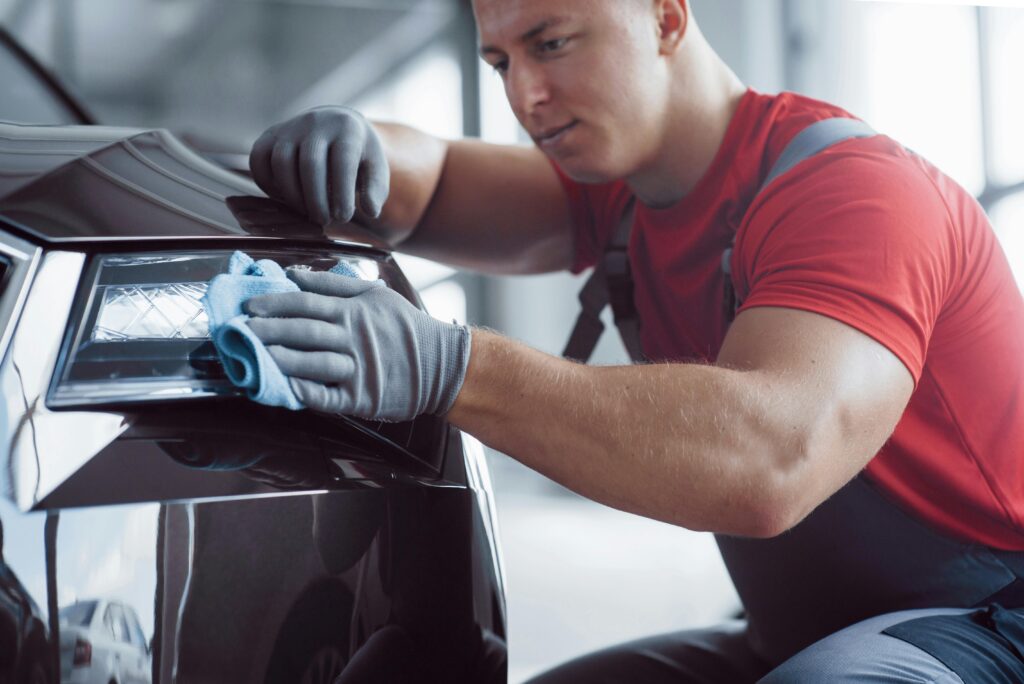
- One panel, one clean side of the mitt. Rinse the mitt constantly. Straight lines, light pressure, no circles. If the mitt feels gritty, stop and rinse it.
- Retire the towels afterward. The mitt and drying towels you used on ash now hold abrasive particulate. Wash them separately or, honestly, use them for wheels from here on out and buy new ones for paint.
- Dry with air or a fresh plush towel. Blotting beats dragging. Don’t let it air-dry into water spots on top of everything else.
- Don’t forget the cabin. Ash gets pulled through the intake. A cabin air filter is cheap and it’s the difference between clean air and re-circulating fine particulate every commute.
What we tell people about coatings and film
| Protection | What it does with ash | What it doesn’t do |
|---|---|---|
| Ceramic coating | Slicker surface, so ash releases with less contact; better chemical resistance while the coating is intact | Doesn’t make ash harmless. Leave it sitting wet and you can still etch the coating. |
| Paint protection film | Physical barrier on the panels it covers; takes the abrasion instead of your clear coat | Only protects what it covers, and the film itself still needs washing |
| Traditional wax | Some sacrificial barrier | Alkaline residue strips it fast; needs frequent reapplication |
| Nothing | — | Bare clear coat takes the full chemical and abrasive load |
If you’ve been on the fence about protection, ash season is the honest argument for it — not because it makes you immune, but because it buys you time and makes the wash safer. We’ve written up whether ceramic coating is worth it in San Diego and how PPF compares to ceramic if you want the real cost breakdown.
When you actually need paint correction — and when you don’t
Here’s the part where I talk you out of spending money.
After a proper wash, look at the paint in direct sunlight. If it’s glossy and uniform, you’re done. Ash that was removed promptly usually leaves nothing behind, and paying for a correction you don’t need is just paying to remove clear coat.
You need a closer look if you see fine swirls in the sun that weren’t there before, dull patches that don’t come back with a wash, or small round marks that catch the light on horizontal panels — hoods, roofs, trunk lids, where ash sits longest. Those are the etching signatures.
Even then, a lot of it comes out with a light single-stage polish rather than the full multi-stage. And I’ll be straight with you about the limit: where alkaline residue has etched deeply into clear coat, we can improve the appearance significantly, but we won’t promise to remove it entirely. Anyone who guarantees that outcome before seeing the panel is guessing. We’d rather look at it and tell you honestly what’s achievable. That’s how we’d want to be treated. More detail on that here: what paint correction costs and when to skip it.
A note from the crew
The thing our guys see most often after a wind event isn’t ash damage — it’s wipe damage. Someone comes out in the morning, sees the dust, grabs whatever towel is in the trunk, and gives the hood a quick swipe so they don’t look grubby at work. Twenty seconds, and it puts a haze across the most visible panel on the car.
If you take one thing from this: leave it alone until you can rinse it. A dusty car looks better than a scratched one, and it stays that way for about ten minutes anyway.
Frequently asked questions
Can I just run it through an automatic car wash?
Not a brush wash — the brushes carry grit from every car ahead of you and drag it across your paint. A quality touchless wash is a reasonable emergency rinse, though it usually won’t fully remove bonded residue. A proper hand wash is the real answer.
How fast do I need to wash it off?
Sooner is genuinely better, especially with our overnight marine layer reactivating it every morning. Within a day or two is ideal. Don’t let a light coat sit for a week.
Does rain take care of it?
No — it makes it worse. Rain wets the ash without removing it, which is the exact condition that lets it etch. A car that’s been rained on after an ash event needs washing more urgently, not less.
What about the glass and wheels?
Same principles. Rinse before contact, pH-neutral products, and be especially careful with polished or chrome wheels — alkaline residue is hard on brightwork and it shows up fast.
We’ll come to you
Our mobile detailing crew handles safe ash removal at your home or office across San Diego County — proper rinse, pH-neutral wash, fresh media, and an honest look at whether your paint needs anything more. Tell us what you’re driving and we’ll quote it.
Amara Berg — San Diego Home Maintenance. We do two things and we do them properly: window cleaning and high-end mobile car detailing, across San Diego County. Follow along at @sdrealestateagent. See what we offer.
General care guidance for San Diego vehicle owners, not a quote and not a guarantee of results on any specific vehicle. Outcomes vary with paint condition, age, and how long contamination has been present; we do not guarantee full removal of etching in clear coat. During any active fire event, follow guidance from CAL FIRE and Alert San Diego first — your car can wait.