
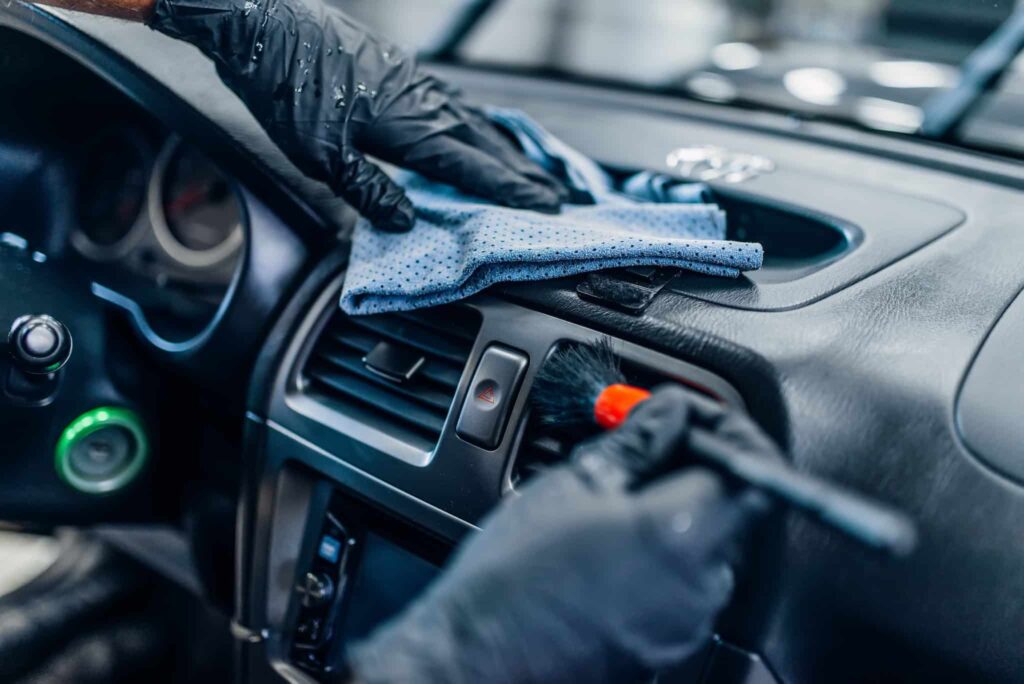
The honest answer to paint protection film vs. ceramic coating is that they are not competing products. Film stops things that hit your car. Coating stops things that land on it. San Diego throws both at you, which is why the shops that sell both keep recommending both.
But most people are not spending $6,000. Most people have a budget and one car and a reasonable question about where the money goes first. So here is how our crew sorts it, including the part where we tell people to buy neither.
Key takeaways
- PPF is physical armor. Urethane film, roughly 8 mils thick, that absorbs rock chips and road debris. Typically rated 5 to 12 years depending on tier.
- Ceramic coating is chemical armor. A hard, slick layer that resists UV, water spotting, salt film, and bird droppings. Professional installs typically last 2 to 9 years by tier.
- Film cannot go everywhere affordably. Coating can go everywhere. That is the whole reason the standard recommendation is film on impact zones, coating over the entire car.
- San Diego County pricing generally runs $1,700–$3,400 for a professional full-front PPF install, with full-car wraps climbing well past $5,000. Coating-only packages sit far below that.
- If you have one budget and a coastal commute, coat first. If your commute is I-5 or I-15 at freeway speed, film the front first. Those two sentences resolve about 80% of the calls we get.
Who this is for
This is for the San Diego owner who just took delivery of something nice — a new SUV, a German sedan, a truck that cost more than our first house — and got handed a protection menu at the dealership with numbers on it that felt made up. And it is for the person three years in, looking at a hood that has picked up a constellation of chips from the 5, wondering if it is too late.
There is a real feeling underneath this and it is not vanity. You bought something you take care of, you live in a place that is quietly hostile to paint, and you do not want to watch it get ugly on your watch. That instinct is correct. It is also extremely easy to overspend on.
What San Diego actually does to a car
Every region eats paint differently. Ours does it three ways, and this summer was a strong showing for all three — we came off a stretch of near-record late-August heat before things finally cooled back to average this week, per the National Weather Service in San Diego.
- UV, year round. We do not get a winter off. Sustained ultraviolet exposure is what oxidizes clear coat and fades trim, and the EPA’s UV Index stays meaningfully elevated here through fall. This is a coating problem. Film helps on the panels it covers; coating covers all of them.
- Salt aerosol and hard water. Coastal air carries salt inland further than people think, and San Diego’s tap water runs around 13 grains per gallon of hardness. Sprinkler overspray plus salt film is what etches minerals into clear coat — the same fight we describe in hard water stains on windows, just on a $90,000 painted surface. Coating problem.
- Freeway debris. The 5, the 15, the 8, and every stretch of construction between them. Rock chips on the hood, bumper, mirrors, and A-pillars. This is the one coating cannot help with at all. Film problem, full stop.
Side by side, honestly
| Paint protection film (PPF) | Ceramic coating | |
|---|---|---|
| What it is | Clear urethane film, physically applied | Liquid polymer that cures into a hard layer |
| Stops rock chips | Yes — this is its entire job | No |
| Stops UV fade and oxidation | On covered panels only | Yes, everywhere |
| Stops water spots and salt film | Partially | Yes — and makes them wipe off |
| Self-heals light swirls | Yes, with heat, on quality film | No |
| Typical lifespan | 5–12 years by tier | 2–9 years by tier |
| Typical San Diego cost | $600–$1,500 partial front · $1,700–$3,400 full front · $5,000+ full car | Substantially less for whole-car coverage |
| Easy to wash | Normal | Noticeably easier |
One thing worth understanding about PPF pricing: roughly 70 to 80% of it is labor. Film is genuinely difficult to install cleanly — edges, complex curves, hood corners. That is why a cheap PPF quote is a warning, not a bargain. A badly wrapped hood with lifting edges looks worse than an unprotected one and costs money to remove.
Coating makes your car easier to keep clean. Film makes your car harder to damage. If you cannot articulate which of those you are actually worried about, you are not ready to spend the money yet.
How we’d spend three different budgets
The modest budget
Decontaminate, one-step polish to correct what is already there, then a quality coating over the whole car. You get UV protection on every panel, water spots that wipe instead of etch, and washes that take half as long. You do not get chip protection. For a coastal-parked commuter that is the right trade, and we walked through the coating side of it in is ceramic coating worth it in San Diego.
The middle budget
Full-front PPF — bumper, hood, fenders, mirrors, A-pillars — plus coating over the rest of the car and over the film itself. This is the configuration we recommend most often, because it puts armor exactly where San Diego freeway debris lands and chemical protection everywhere else. In our county it usually lands in the low-to-mid four figures depending on the vehicle.
The no-ceiling budget
Full-car PPF with a coating on top. Genuinely excellent, genuinely expensive, and honestly overkill for most vehicles. It makes sense on a low-production car, a long-term keeper, or something with paint that is difficult or impossible to match if it gets damaged.
When we tell people to skip both
We turn this work down regularly, because there are cars where the money simply does not come back.
- The clear coat is already failing. Neither product bonds properly to peeling or heavily oxidized clear. You need paint, not protection.
- You are selling within a year. Coatings and film do not raise resale in any reliable way. A pre-sale detail does far more per dollar — that math is in should you detail your car before selling.
- It is a lease you turn in next year. Return standards do not reward protection. Keep it clean and hand it back.
- The car lives in a garage and does 4,000 miles a year. A good sealant and regular washing will genuinely do the job.
- The paint needs correction you are not budgeting for. Sealing swirls under a coating locks them in for years. Correct first — see paint correction in San Diego — or wait until you can do both.
That last one matters more than any product choice. Prep is most of the result. A mid-tier coating over properly corrected paint beats a flagship coating rushed onto a dirty car every single time.
Frequently asked questions
Can you put ceramic coating over paint protection film?
Yes, and you generally should. Coating over film keeps the film cleaner, adds hydrophobic behavior, and helps the whole car look and feel consistent rather than having glossy film panels next to untreated ones.
Does PPF yellow over time?
Older films did, badly. Modern quality urethane with a proper top coat holds up far better, which is why brands rate them 5 to 12 years. Budget film from an unknown supplier is still a real risk here, particularly under year-round San Diego sun.
Do I still have to wash a coated car?
Yes. Coating changes how often and how hard, not whether. In our climate we suggest roughly every two weeks for coastal-parked cars — salt film builds regardless of how slick the surface is. Skipping washes is the most common way people get disappointed by a coating they paid for.
Is dealership-applied protection the same thing?
Sometimes it is a genuine professional coating and sometimes it is a sealant with a warranty document attached. Ask what specific product is being applied, who applies it, whether the paint gets corrected first, and what the warranty actually requires of you. The answers vary enormously.
Tell us the car, the commute, and the budget
Send the year and model, where it parks, and roughly what you are willing to spend. We will come back with the shortest configuration that actually solves your problem — and if the honest answer is “skip both and get it detailed twice a year,” that is what we will tell you. We come to you anywhere in San Diego County.
— Amara & the SD Home Maintenance crew. We do luxury mobile car detailing and window cleaning across San Diego County. Between back-to-school drop-offs this month — we have one starting kindergarten — our own family car took the same summer beating yours did, so this is not a hypothetical around here. See our services or read the FAQs.
Pricing ranges are typical San Diego County estimates for planning purposes, not quotes — actual cost depends on vehicle size, panel complexity, paint condition, and film or coating tier. Lifespan figures reflect general product-tier norms and manufacturer ratings, not a guarantee of performance on any individual vehicle. Nothing here is a warranty, and no protection product prevents all damage.