
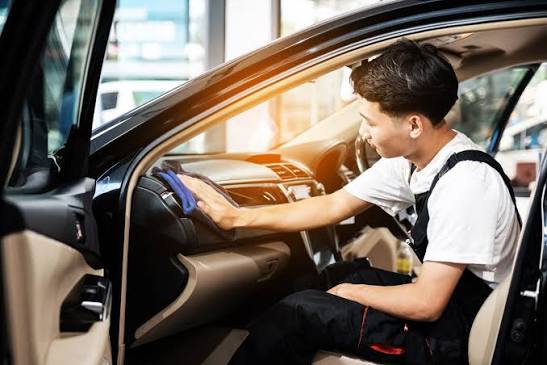
Car interior sun damage in San Diego almost always shows up on the passenger side first. That is the side that faces the street in most driveways, it takes the afternoon sun, and it is where a dash starts to gray, then chalk, then split. By the time an owner notices, the material has usually been breaking down for two or three years.
Our crew sees this in a pattern. When a detail is booked for the outside of the car, we walk the interior first, and the one thing we can call before opening a door is which half of the dashboard is worse.
Who this is for
San Diego owners who park outside. That is most of us — a driveway in Poway, a street spot in Pacific Beach, an uncovered space at the office in UTC. Your car looks great from ten feet away because you take care of the paint. Then you open the door on a September afternoon and the cabin is 140 degrees, the dash has a dull haze across it, and the driver seat bolster is a different color than the passenger one.
It is a quietly expensive problem. Interior condition moves resale value more than most people expect, and unlike a swirl in the clear coat, a cracked dash is not something anybody buffs out.
What is actually happening in there
Two forces, working together.
UV breaks the material down chemically. Dashboards and door cards are mostly plastic and vinyl, and those polymers rely on plasticizers to stay flexible. Ultraviolet light cleaves those chains. The surface loses its plasticizer, goes brittle, loses color, and eventually cracks along whatever line already had stress in it — the defroster vents, the airbag seam, the edge above the glove box.
Heat accelerates all of it. A closed car in direct sun runs far hotter than the air outside. That heat drives plasticizer and moisture out of the material faster, dries the oils out of leather, and softens the adhesives holding trim and headliner in place. The sagging headliner and the peeling steering wheel are the same story as the cracked dash.
Why San Diego is worse than the weather report suggests
Our climate is deceptive. Coastal highs sit in the mid-to-upper 70s in September, which feels gentle, so nobody thinks of it as harsh on a car. But the UV index here averages around 10 in September — very high — and stays around 7 through October. UV does not care that the air is pleasant.
Then there is Santa Ana season, which peaks from September into November. When that offshore flow kicks in, the marine layer disappears and inland days run 15 to 20 degrees above normal. Those are the days your cabin bakes. September and October do more interior damage in San Diego than July usually does.
What a detail fixes, and what it does not
| Surface | What damage looks like | What we can actually do |
|---|---|---|
| Dash and door tops | Gray haze, chalky feel, fine cracks | Deep clean and a UV-blocking dressing restores color and slows what is coming. Cracks are permanent. |
| Leather seats | Stiff, faded, cracking at the bolster | Clean and condition brings back suppleness and some color depth. Split hide needs a trim shop, not a detailer. |
| Cloth upholstery | Uneven fading, brittle fibers | Extraction and protectant help. Faded dye does not come back. |
| Steering wheel and shifter | Tacky, shiny, flaking coating | Cleaning removes the tack. A failed factory coating is a replacement. |
| Headliner | Sagging, separating at the edges | Cleaning only. Adhesive failure is upholstery work. |
I want to be straight about that last column, because a lot of shops are not. We do not guarantee reversal of UV degradation. Once plasticizer is gone from vinyl or a dash has cracked, no product puts it back — and anything advertised as making cracks disappear is filling them, not fixing them. What conditioning and protection genuinely do is make the surface look considerably better today and buy you years before the next stage. That is worth doing. It is just not restoration, and we would rather tell you that up front than take your money for a promise we cannot keep.
What actually protects an interior
Most of this you can do yourself, and you should.
- A reflective windshield shade. Cheapest, highest-return thing on this list by a wide margin. Use it every time, not just on hot days — UV is doing its work at 75 degrees too.
- Quality window film. Good ceramic tint blocks the large majority of UV without going dark, and it cuts heat soak meaningfully. Keep it legal for California front windows.
- A UV protectant on the dash and door tops. Every four to six weeks through the warm months. Use a matte product — glossy dressings create windshield glare and attract dust.
- Leather conditioner every couple of months. The goal is replacing oils, not shining the surface.
- Park with your nose out. If a spot only gets sun from one direction, back in. It puts the sun on the trunk instead of the dash. Free, and it works.
When to skip it
If your dash is already cracked across the top and the leather has split at the seams, an interior detail is a cosmetic improvement, not a save. Sometimes the honest answer is to spend that money at an upholstery shop instead, or to leave it alone and put the budget toward paint, which is where a car this age usually recovers more value. The exception is if you are selling — a cleaned, conditioned interior on an older car still reads as cared for, and that impression is worth real money at the curb. We covered that math in our post on detailing a car before selling it.
FAQ
How often should I have the interior detailed in San Diego?
Twice a year for a daily driver parked outside, with your own protectant applied between visits. Garage-kept cars can stretch to once a year. Full detail specifics are in our guide to car interior detailing in San Diego.
Do the shiny dashboard sprays actually protect anything?
Some do, many are silicone gloss with no meaningful UV package. Look for a product that names UV blockers on the label, and pick matte over glossy.
Is a cracked dash worth repairing before I sell?
Usually not. A dash cover or an honest disclosure costs far less than the repair, and buyers of a sun-belt car largely expect it.
Does tint help if my windshield already has the factory UV coating?
Factory laminated windshields block a good deal of UVB but pass more UVA than people assume, and they do nothing about the side glass your passenger seat faces. A shade plus film still changes the outcome.
Get your interior looked at before Santa Ana season peaks
We come to you — driveway, office lot, wherever the car sits. Tell us what you are seeing and we will give you a straight read on what is fixable, what is not, and what it costs. No pressure to book the biggest package on the menu.
Amara Berg — I run San Diego Home Maintenance. We do window cleaning and high-end mobile auto detailing across the county, and most of what I write here comes straight off the job. If you want the exterior side of this, see what sun and minerals do to paint in our post on water spots on car paint, or browse our services.
Pricing and timelines here are general guidance, not a quote — every vehicle is different. We do not guarantee removal of UV degradation, restoration of cracked or chalked plastic and vinyl, or reversal of faded dye and split leather.