
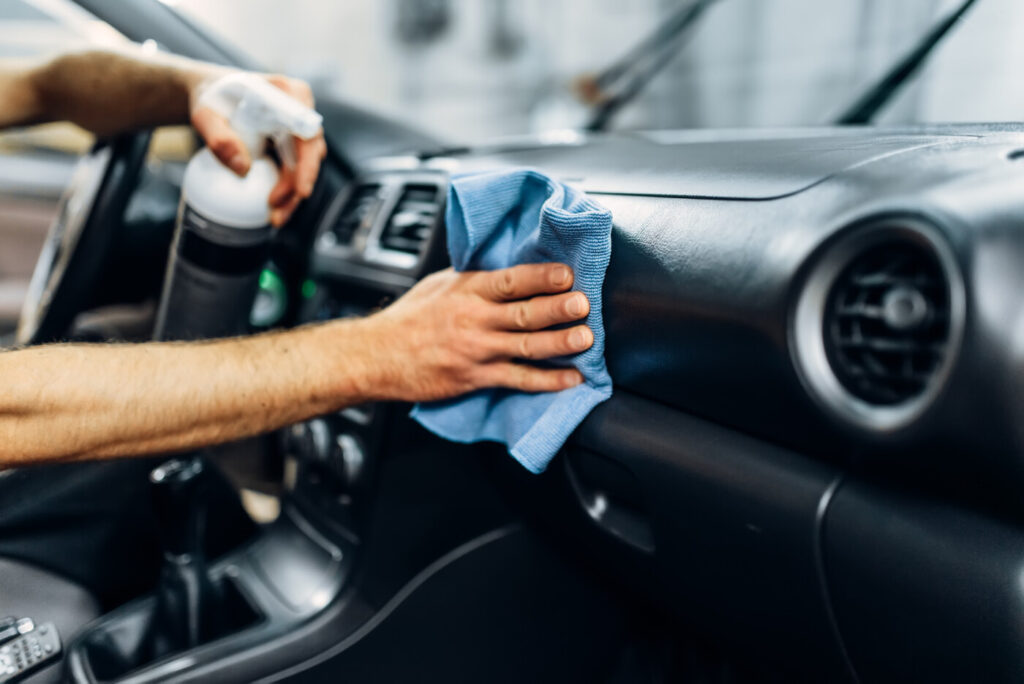
Car interior detailing in San Diego isn’t about how the cabin looks — it’s about slowing down three things that are actively taking your interior apart: ultraviolet light, salt air, and sand. Late August is when all three are at their worst, and it’s the single best time of year to get ahead of them.
We were detailing a car in Pacific Beach last week where the driver’s-side bolster had gone chalky and stiff while the passenger seat, six feet away, still looked new. Same car, same age, same owner. The difference was afternoon sun through one window and a decade of sandy towels on one seat. That’s the whole story of interiors in this city.
Key takeaways
- Researchers at UC San Diego School of Medicine and Arizona State University measured dashboards averaging 157°F after an hour parked in summer sun, with cabin air at 116°F and seats at 123°F.
- Parked in shade, the same cabins came in closer to 100°F. Where you park is a bigger variable than what you spend.
- Heat plus UV is what cracks a dash and dries out leather. Salt and sand are what abrade the surfaces that heat already weakened.
- A real interior detail is decontamination first, conditioning second. Anybody who leads with a shiny dressing is selling you the wrong order.
- Twice a year is plenty for most San Diego drivers. We’ll tell you if you’re not one of them.
Who this is for
Coastal San Diego drivers — La Jolla, PB, Del Mar, Coronado, Point Loma — and anybody who parks outside, drives to the beach, or owns a car with a nice enough interior that replacing a cracked dash would genuinely hurt. If you’ve got leather or Alcantara and you street-park in the sun, this one’s for you.
The number that explains everything
A team from UC San Diego School of Medicine and Arizona State University, publishing in the journal Temperature, parked identical vehicles in summer sun and measured what happened inside. After one hour, the average cabin hit 116°F, seats reached 123°F, steering wheels 127°F — and dashboards averaged 157°F, with peaks above 165°F. Cars parked in the shade stayed nearer 100°F inside.
Now think about what that does to materials, hundreds of times a summer. Plasticizers — the compounds that keep vinyl and dash plastics flexible — migrate out under sustained heat. Leather loses moisture. Adhesives soften. Then it cools overnight and does it again tomorrow. Nothing dramatic happens on any single day, which is exactly why people don’t act until there’s a crack.
UV and heat do the damage. Salt and sand just make sure it shows.
San Diego’s three-part attack on your interior
| Culprit | What it actually does | Where we see it first |
|---|---|---|
| UV + heat | Drives plasticizers out of vinyl and dries the finish on leather until it stiffens, fades, then cracks | Top of the dash, rear deck, driver’s seat top bolster, steering wheel |
| Salt air | Settles as a fine hygroscopic film that holds moisture against surfaces and corrodes seat rails, buckles, and trim screws | Door sills, seat tracks, seatbelt hardware, anything metal near a window you leave cracked |
| Sand | Pure abrasive. Grinds into carpet backing and works into seat perforations and stitching seams | Driver’s footwell, under seats, perforated leather, cargo area |
That third one is the sneaky one. Sand in perforated leather doesn’t look like anything — until the perforations start to look grey and the seam thread frays from the inside. Vacuuming the surface doesn’t reach it. Compressed air and a soft brush do.
What a real interior detail includes
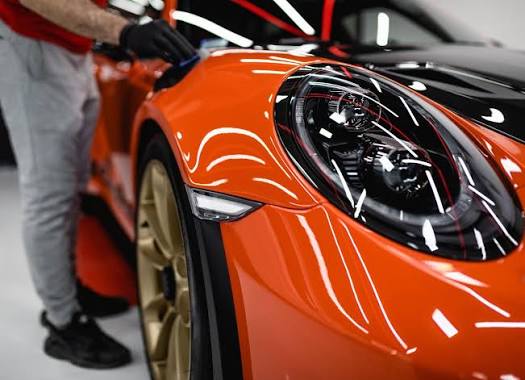
- Full extraction, not a pass with a shop vac. Seats out of the way where possible, compressed air through the seams, then vacuum.
- pH-appropriate cleaning by surface. Leather, Alcantara, cloth, piano-black trim, and screens all want different chemistry. One all-purpose cleaner across everything is how trim gets hazed.
- Leather decontamination before conditioning. Conditioning dirty leather seals the grit in. This is the step most cheap details skip because it’s the slow one.
- A UV-inhibiting protectant with a matte finish. Glossy dressings look great in a photo and throw glare into your windshield at 5 p.m. on a westbound drive. We don’t use them.
- Glass cleaned inside. Interior glass film is mostly off-gassed plasticizer — literally your dashboard, condensed. Cleaning it is a good proxy for how hard the cabin has been cooking.
When we tell people to skip it
We’d rather keep a customer than sell a service they don’t need, so — honestly:
- You garage the car and rarely drive it. A garaged interior in San Diego ages slowly. Once a year is fine. Save the money.
- The dash is already cracked. Detailing won’t reverse it. That’s a trim or repair conversation, and we’ll say so rather than take your money for cosmetics.
- You’re selling the car in the next month. Then you don’t want a maintenance detail — you want a pre-sale detail, which is a different scope aimed at photos and first impressions.
- A $20 windshield sunshade would fix 60% of your problem. Buy the sunshade first. Come back to us in six months and you’ll need less work.
A realistic cadence for San Diego
| How you use the car | Full interior detail | Protectant refresh |
|---|---|---|
| Garaged, low mileage, inland | Once a year | Once a year |
| Street-parked inland, commuter | Twice a year | Every 3–4 months |
| Coastal, street-parked, beach trips | Twice a year (late summer + after the first rains) | Every 2–3 months in summer |
| Convertible or light-colored leather, coastal | Three times a year | Every 6–8 weeks in summer |
Late August into September is the ideal slot for the big one — you’re clearing out a full summer of salt and sand right before the marine layer and the first rains change what the car is dealing with. If you’re also thinking about the outside of the vehicle, our guide to mobile car detailing in San Diego covers the full picture, and we’ve written separately about whether ceramic coating is worth it here.
Frequently asked questions
How long does an interior detail take?
A thorough one runs three to five hours depending on size, material, and how much sand we’re excavating. Anything advertised at 45 minutes is a cleaning, not a detail — which is a fine thing to buy, as long as you know that’s what you bought.
Can you do it at my house?
Yes — we’re mobile, so we come to you. A driveway, a carport, or a shaded street spot all work. Shade helps, because working on a 157°F dash is bad for the products and bad for the result.
Will conditioning fix leather that’s already stiff?
It can bring back a meaningful amount of suppleness if the finish is dry but intact. If the topcoat has already cracked, conditioning improves feel but won’t close the cracks. We’ll look at it and tell you which one you have before we start.
Do window tint and sunshades really help?
They’re the highest-return things you can do. Quality tint blocks the large majority of UV, and a windshield shade cuts direct load on the dash — the hottest surface in the car by a wide margin. Detailing maintains the interior; those two protect it.
Get a free interior detailing quote
Send us a couple of photos of your interior and where you park. We’ll tell you what it needs, what it doesn’t, and what it costs — and if the honest answer is “a sunshade and check back in six months,” we’ll say that instead.
— Amara & the SD Home Maintenance crew
We do window cleaning and luxury mobile car detailing across San Diego — coastal salt, hard water, sun-baked interiors, all of it. We’d rather tell you to skip a service than sell you one you don’t need.
Temperature figures cited are from research by UC San Diego School of Medicine and Arizona State University published in the journal Temperature, and reflect measured averages under specific test conditions — your vehicle will vary with color, glazing, tint, and parking. Cadence recommendations are general guidance based on our field experience in San Diego, not manufacturer instructions; always follow your vehicle maker’s care guidelines for your specific materials.